Porto’s Pink Line Year
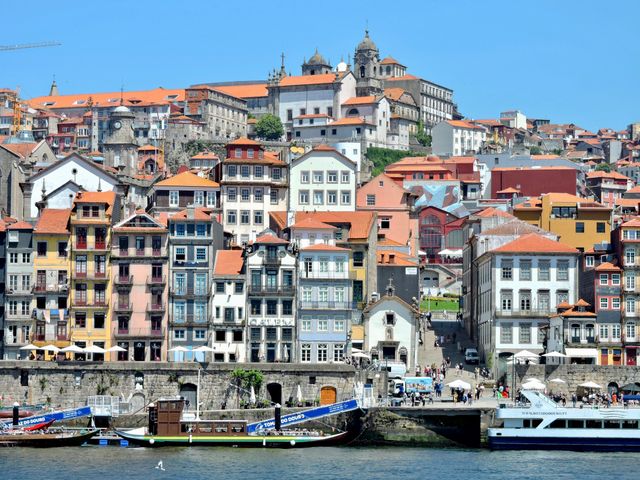
Four new stations are being tunnelled under the historic centre, the nightly tax is three euros, and the Ribeira has become largely somebody else's photograph.
Porto is midway through the biggest change to its transport in a generation, and visitors in 2026 meet it as roadworks. The Rosa line, four underground stations running east to west beneath the historic centre, slipped to early 2026 with night-time street closures around Praca da Galiza while track and signalling go in. A second line, Rubi, crosses the Douro to Gaia later in the year on a new light-rail bridge. Add a three-euro nightly tourist tax and a riverfront that now functions mainly as a backdrop, and the argument for Porto rests on the streets uphill from the water.
Three euros a night, capped at twenty-one
Porto’s municipal tourist tax is three euros per person per night, collected by the accommodation and capped at twenty-one euros for stays of seven consecutive nights or longer. The council publishes a list of exemptions that is broader than most cities bother with.
Children aged twelve and under do not pay. Nor do patients receiving medical treatment and up to two companions, people with a recognised incapacity of sixty per cent or more and up to two companions, pilgrims on their first night in a pilgrim hostel, residents of state or municipal social housing, or asylum seekers displaced from their own countries. Documentation is required in every case. The charge may be taken at the start, the middle or the end of a stay at the operator’s discretion, which is why it sometimes arrives as a surprise at checkout.
Four stations under the old town, and a station worth arriving at
The Rosa line is short and disproportionately consequential: roughly three kilometres and four stations, at Sao Bento II, Hospital de Santo Antonio, Galiza and Casa da Musica II, forming an east to west spine that finally links the historic centre to the institutional quarter underground. Its opening was pushed into early 2026 after a target that had originally been 2023.
The Rubi line is the larger project, 6.4 kilometres south from Casa da Musica to Santo Ovidio in Vila Nova de Gaia, crossing the Douro on the new Ponte D. Antonia Ferreira, a light-rail bridge designed to protect the UNESCO sight-lines along the gorge. Partial service is expected late in 2026 with completion running into 2027. Both lines fold into the existing Andante zone fares rather than carrying a premium.
For a visitor in the meantime, the effect is nightly closures around Galiza, hoardings in the middle of the walking city, and a genuine improvement waiting on the other side of it.
The tiled entrance hall at Sao Bento is the most photographed interior in the city and it is also a commuter station, which is the right way to meet it: somewhere people are late for a train, rather than a monument with a ticket barrier. It sits at the top of the historic centre, which makes arriving by rail from Lisbon or from Vigo a considerably better introduction to Porto than arriving at the airport.
The airport link is, in fairness, among the better ones in Europe. The metro runs into the centre at an ordinary fare with no express premium, and once the two new lines are running the argument against renting a car here becomes close to unanswerable. That matters in an old town built as a slope of one-way lanes with nowhere to leave a vehicle at the end of them.
Ribeira is a photograph; the cellars are in another city
The riverfront terrace under the Ponte Luis I is the image that sells the city and it is the least representative part of it: a single row of restaurants pricing for a captive audience, backed by buildings that are increasingly short-let rather than lived in. Half an hour there is plenty.
The city that justifies the trip is above it. Cedofeita and Miguel Bombarda for galleries and independent retail, Bolhao and its rebuilt market hall, the Fontainhas balcony over the gorge, Foz do Douro where the river meets the Atlantic and the surf clubs start. Porto is also a genuinely steep city, and the granite setts are slippery in rain, which arrives frequently enough that it belongs in a packing list rather than a footnote.
Every major port house sits on the south bank in Vila Nova de Gaia, which is a separate city with its own council, its own rules and, notably, no Porto tourist tax. Crossing the lower deck of the Ponte Luis I on foot takes minutes, and the price difference in accommodation is often material.
The lodge tours themselves range from serious to perfunctory, and the ones attached to the largest brands are the most industrialised. The smaller houses give more time and better wine for the money. It is also worth saying plainly that a port tasting is not a substitute for the Douro valley, which is three hours upstream and is the actual landscape the wine comes from.
One practical consequence of the municipal boundary: hotel bookings on the Gaia side are quoted without Porto’s nightly charge, and the view from there is of Porto rather than of Gaia, which is the view most people came for.
Rain is a planning input, not a footnote
Porto is one of the wetter cities in southern Europe and the winter is genuinely damp rather than merely cool. That produces a real seasonal trade-off: June to September is dry, warm and crowded, with cruise arrivals and a compressed old town; November to March is quiet, cheap and frequently wet.
The best compromise is May or late September, when the Douro valley is either green or in harvest and the coastal fog that locals call the nortada has not yet settled in for the summer afternoons. Sao Joao, on the night of 23 June, is the city’s great street festival and is the one date when Porto is as busy as Lisbon.
Sources: Camara Municipal do Porto: Municipal Tourist Tax leaflet · The Portugal Post: Porto’s twin metro lines · idealista: tourist tax in Portugal, 2025 rates · Host Wise: tourist tax in Portugal, 2026 guide
Articles on Read Vault are researched and written by the site’s editorial team.