Hoi An, Lisbon and Oaxaca: the same craft-and-food trip, priced three ways
Three heritage cities where eating and workshops are the point. What each charges, what each restricts, and which rewards a full week rather than three days.
Nobody flies to all three of these in one year, so ranking them is pointless. What connects them is a specific trip: a walkable historic centre where the reason to be there is what people make and cook. A reader who wants that holiday is genuinely choosing between continents, and the choice turns on cost structure, crowd pressure and how the local authority has decided to charge visitors. One sells a ticket at the gate. One adds a nightly line to the hotel bill. One barely charges at all, and that is currently its biggest problem rather than its selling point.
One trip type, three continents
The shape is identical in each: a compact old centre, a market that opens early, a craft tradition with workshops attached, and a food culture worth building days around. Hoi An has tailoring and Quang noodles. Oaxaca has black pottery, weaving and a mole tradition that supports a week of eating without repetition. Lisbon has tiles, tinned fish and a pastry that has been copied badly across the world.
Where they diverge is in how much of the experience has been packaged. Hoi An’s centre is explicitly managed as a heritage product. Oaxaca’s is not managed much at all. Lisbon sits between the two, with a historic core that has been reshaped by a housing market rather than by a heritage authority.
Hoi An charges you at the gate
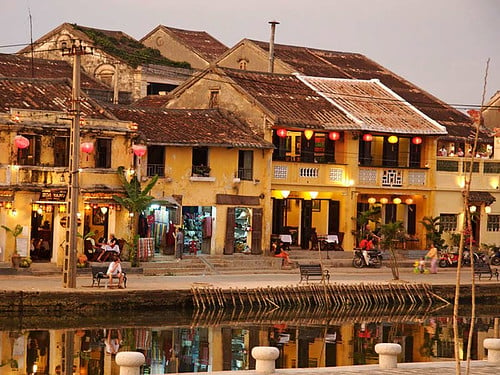
The Ancient Town operates a ticketing system, and it is unusually explicit about what the money buys. An 80,000 dong ticket covers the shared spaces, one major site such as the Japanese Covered Bridge or Quan Cong Temple, and two further cultural attractions. A 120,000 dong ticket adds museum access and a third venue. A single purchase remains valid for up to three days across a stay, and groups of eight or more receive a guide at no extra cost.
The town also closes streets on a timetable. Pedestrian hours run from 09:00 to 21:30 in summer and to 21:00 in winter across the Ancient Town, with Phan Chau Trinh Street restricted from 17:30. Traditional art performances run at fixed times through the day. This is a heavily curated environment, which some travellers find reassuring and others find airless. Getting in is straightforward for British visitors, who have a 45-day visa waiver that cannot be extended; the alternative is a 90-day e-visa at 25 US dollars single entry or 50 for multiple entries.
Lisbon charges you at the desk
Portugal’s capital applies a municipal tourist tax of 4 euros per person per night, capped at seven consecutive nights, with children under 13 exempt. It doubled from 2 euros in September 2024. A couple staying a week therefore contributes 56 euros on top of the room, which is not trivial but is not the reason Lisbon has become expensive either.
The reason is housing. Monthly housing costs in Portugal’s major cities consume between 35 and 50 per cent of median household income, against a European benchmark of 25 to 30 per cent, and Lisbon property runs to roughly 4,500 euros per square metre. In March 2026 the Casa para Viver platform, drawing on close to 90 organisations, coordinated protests across 16 Portuguese cities. Visitors are not the cause of that on their own, but a short-let apartment in Alfama is a visible participant in the argument.
Oaxaca barely charges at all, and that is the story
There is no entrance ticket to the centre, no timed pedestrian zone and nothing to pre-pay at the border for most Western passports. On cost alone Oaxaca comfortably undercuts the other two.
The uncomfortable context is that visitor numbers have gone the wrong way. Hotel occupancy during the 2026 Guelaguetza reached roughly 38 per cent, the lowest since the pandemic, against 48 to 50 per cent the previous year and 67 to 72 per cent in 2019. Hoteliers blamed weak promotion, the replication of Guelaguetza-style performances in other states and in the United States, a softer economy, security perceptions and the shift of bookings to short-term rentals. A traveller benefits from all of this in the short term. It is not a sign of a healthy destination.
Heat, rain and the weeks to avoid
Each has a season that will spoil the specific thing you came for. Hoi An’s central Vietnamese autumn brings flooding that closes riverside streets outright. Lisbon in August is hot, full and priced accordingly, and the tiled interiors that make the city bearable are the ones with queues. Oaxaca’s rains fall in summer, which is also when the Guelaguetza brings whatever crowd it can still draw.
The workable answer in all three is the same and worth stating once: aim for the shoulder weeks either side of the obvious season, and accept that a few sites will be closed.
The paperwork gap nobody mentions
Entry friction differs more than the tourist charges do. Vietnam requires either the 45-day waiver or an e-visa arranged in advance, and the most frequent cause of rejection is a middle name that does not match the passport exactly. British applicants should note that the waiver cannot be extended once in the country, so a longer stay means paying for the 90-day e-visa from the outset. Mexico and Portugal both wave most Western passports through with nothing pre-paid, which makes Hoi An the only one of the three needing a decision before booking flights.
Which one repays a full week
Oaxaca does, comfortably, and it is the pick for a reader whose budget is the binding constraint. The valley villages support day trips for a fortnight, the food is the best of the three and the current low occupancy means the good places are bookable. The honest reservation is that the state is large and parts of it carry travel restrictions that a valley-based week never touches, so an ambitious road itinerary needs checking against current advice.
Hoi An repays three or four days and then repeats itself; it is best treated as one leg of a longer Vietnamese trip rather than a destination in its own right. Lisbon repays a week only if you leave the centre regularly, because the historic core is now the most contested and least local part of the city. For a first-time traveller who wants craft, food and low friction in a single place, Oaxaca is the clear-eyed choice, and the other two are better as chapters.
Sources: Da Nang tourism portal, Hoi An Ancient Town entrance tickets 2026 · Vietnam e-visa guidance for UK citizens · Portugal tourist tax 2026, verified rates by region · The Portugal Post, housing affordability protests · Rio Times, Oaxaca hotel occupancy during Guelaguetza
Articles on Read Vault are researched and written by the site’s editorial team.