Aqara Presence Sensor FP2: The $50 Sensor in the Same Catalogue Has the Protocol This One Lacks
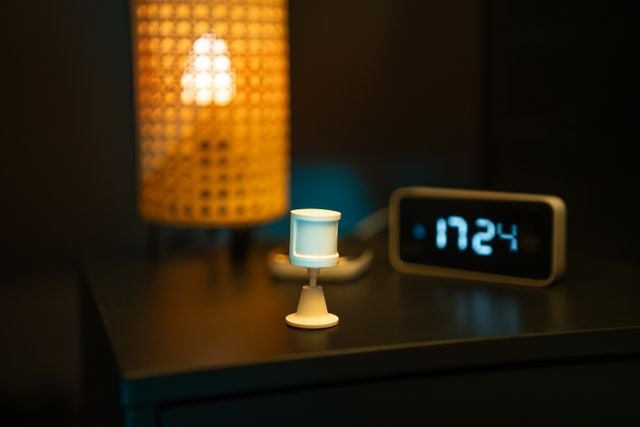
Aqara's store sells the FP2 at $82.99 and lists its Matter support as No. The FP300, announced at $50, does Matter over Thread and Zigbee.
Aqara’s US store sells the Presence Sensor FP2 for $82.99 and, in its own specification table, lists Matter support as No. In November 2025 Aqara announced the Presence Multi-Sensor FP300 at $50: battery powered, dual mmWave and PIR, and Matter over both Thread and Zigbee, so it joins Apple Home with no hub involved. The FP2 is now the most expensive and least modern-protocol presence sensor in Aqara’s own range. It still does three things the FP300 cannot, and whether you need those three things is the entire decision.
FP2 and FP300, from Aqara’s own pages
- FP2: $82.99, wired 5V USB-C, Wi-Fi 2.4GHz only, Matter listed as No
- FP300: announced at $50, two CR2450 cells, Matter over Thread and Zigbee
- FP2 keeps: up to five people tracked, up to 30 zones, fall detection when ceiling-mounted
- FP300 drops: multi-person detection, sleep tracking, fall detection
- FP2 coverage: 15m maximum range, up to 40 square metres, IPX5, no hub required
The cheaper sensor has Matter; the dearer one does not
The FP300 was announced on 12 November 2025 at $50. It runs on two CR2450 cells, which Aqara rates at roughly two years on Thread and claims may reach three, pairs mmWave radar with a PIR element across a 120-degree field of view to six metres, and throws in ambient light, temperature and humidity sensing. The part that reorders the range is Matter: over Thread and over Zigbee, which means it appears in Apple Home directly with nothing between it and the phone.
The FP2 does none of that. It is wired over USB-C at 5V and one amp, speaks 2.4GHz Wi-Fi and Bluetooth 4.2, and its Matter row reads No on Aqara’s own store page. HomeKit, Alexa and Google Home integrations exist, but they are Aqara-maintained connections rather than a standard, which is a materially different guarantee in 2026.
Aqara does not frame the two as replacement and replaced. Its own comparison page calls them complementary: the FP2 for safety work and zone-specific automation, the FP300 for environmental monitoring across larger rooms. That is a fair description of the capability split. It does not change the fact that the older, dearer product is the one without the protocol. Above both, Aqara showed a Spatial Multi-Sensor FP400 at CES 2026 with multi-person spatial tracking, fall detection and headcount, but published neither a price nor a date.
One genuine advantage the FP2 keeps is that it needs no Aqara hub. Aqara states plainly that the sensor integrates without one, which for a household that owns no other Aqara kit removes a purchase and a box from the shelf. The FP300 reaches the same end by a different route, through Matter, and a Thread border router already exists in most homes running Apple Home or Google Home. The FP2’s independence was a real selling point in 2023 and is a less distinctive one now.
Two hours of setup, and a room map drawn by hand
Reviewed.com listed very difficult to set up as its primary criticism and reported spending roughly two hours across multiple sessions getting the sensor working. The automatic room-edge detection, which is supposed to find walls for you, failed completely. What replaced it was mapping the room wall by wall on an in-app grid that refreshed so slowly the reviewer had to force-close the app repeatedly.
The verdict was a conditional maybe, aimed only at people prepared to tinker a lot. That is a narrower audience than the price implies, and it is worth setting against the FP300’s proposition, where a Matter QR code and two batteries is the whole procedure.
Zones that only fully exist inside Aqara’s app
The FP2’s headline capability is zoning: up to 30 of them, with up to five people tracked at once. The catch documented by Reviewed.com is where those zones are usable. There is no native HomeKit support for presence zones, complex automations need routing through Apple Shortcuts, and Alexa and Google Assistant cannot fully use the zone features at all. Buy the FP2 for zones and you have bought into the Aqara app.
Home Assistant users get further. The sensor works through the HomeKit Controller integration with a separate entity per zone, and a firmware update numbered 1.1.6_0005.0025 made local control function without an internet connection. Zone configuration still has to happen in the Aqara app, so a fully local setup was not achievable even there.
One thing this review will not give you is numbers for detection latency, power draw or false positives. SmartHomeScene describes presence detection as instant but publishes no figures, and states outright that it did not measure power consumption. Any specific millisecond claim you read about the FP2 is not coming from a measurement anyone has published.
The physical specification is not the weak point. Aqara rates the sensor to a maximum range of 15 metres and coverage of about 40 square metres, roughly 430 square feet, with an IPX5 rating and a built-in light sensor so that automations can take ambient brightness into account without a second device. That is a large room’s worth of coverage from one unit, and it is more than the FP300’s six-metre, 120-degree cone will do.
The three jobs that still send you to the FP2
There is a real case for the more expensive sensor, and it is narrow enough to state exactly.
- Counting or distinguishing more than one person in a room, which the FP300 does not do
- Fall detection from a ceiling mount, for a bathroom or a relative’s bedroom
- Sleep tracking, and fine-grained zones in a room where a single presence signal is too blunt
- A permanent USB-C supply nearby, since wiring is what Aqara’s own comparison page names as the FP2’s placement constraint
Where that leaves a buyer in September 2026
If the requirement is one sensor that notices somebody entering a hallway and turns a light on, the FP2 is the wrong purchase. The FP300 costs $32 less, needs no cable, and speaks a standard rather than an integration, which matters most for the device you least want to reconfigure in three years.
If the requirement is multi-person zoning or fall detection, the FP2 is currently the only thing in Aqara’s range that does it, the FP400 has no price or date attached, and $82.99 plus two hours of grid-drawing is what it costs. That is a defensible purchase. It is not a general recommendation, and Aqara’s own catalogue is the reason.
Sources: Aqara US store · MacRumors · Aqara newsroom · Reviewed.com · SmartHomeScene
Articles on Read Vault are researched and written by the site’s editorial team.