Marrakech at 4.86 Million: The Medina’s Success Problem
Morocco took a record 19.8 million visitors in 2025 and Marrakech absorbed almost a third of the country's bed nights. The strain shows in rents, in water and in the souks.
Marrakech received 4.86 million tourists in 2025 and recorded 13.6 million overnight stays, which is 29.8 per cent of Morocco’s national total in a single city. Those figures explain nearly everything a visitor notices: why medina rents have moved beyond local reach, why the riad you booked was somebody’s family house a decade ago, why residents raise water before they raise anything else. Morocco is targeting 26 million tourists by 2030, the year it co-hosts the World Cup with Spain and Portugal, and the city is being rebuilt for that number now. Visiting during the rebuild is its own specific experience.
One city, thirty per cent of a country’s bed nights
Morocco posted 19.8 million arrivals in 2025, up 14 per cent on the previous year and ahead of its own 18 million target, with tourism receipts of roughly 13.5 billion dollars over the first eleven months. It has overtaken Egypt as Africa’s most visited country. Marrakech carries a disproportionate share of that: a fraction of the population, close to a third of the nights.
Residents describe the consequences in the terms residents always use. The Moroccan outlet Hespress quotes a Marrakech guide on an incredible increase in rents, land prices and housing, and a resident calling the property market a disaster driven by foreign ownership. The riad economy is the mechanism. Every conversion takes a large courtyard house out of family use and puts it into nightly letting, and the medina has been running that conversion for two decades.
There is a straightforward test of whether a medina stay contributes or extracts. Riads staffed locally, buying in the souk and managed by people who live in the city keep money circulating within a few streets. Listings run remotely from Europe do not, and the medina holds plenty of both. The difference is usually visible in the staffing before a booking is made.
Water is the constraint nobody prices in
The same Hespress reporting records a guide’s blunt assessment that water consumption has exceeded normal levels, and Morocco’s water stress is a national rather than a local story. Marrakech sits on the edge of a semi-arid plain and supports golf courses, hotel pools and thousands of riad plunge pools on a supply that has been squeezed by successive dry years. Public bathhouses have previously been closed on drought grounds, which tells you where the pressure falls first.
There is a defensible way to visit and an indefensible one. The defensible version treats a pool as a luxury rather than a baseline, uses a hammam because it is a cultural institution rather than because it is included, and does not book a golf package in a water-stressed city. Nothing about that reduces the quality of the trip, and the alternative is the version residents are being asked to subsidise.
The badge is the difference between a guide and a shakedown
The Foreign, Commonwealth and Development Office is unusually specific about Morocco, and its list is worth reading before the first walk into the souks rather than after it.
- People posing as official guides commonly harass visitors; a genuine guide carries an official badge and local authority permission.
- Pickpocketing and bag-snatching are common in medina quarters, along with motorcycle theft of visible jewellery and handbags.
- Occasional violent crime occurs, and knives have been used against tourists in street attacks.
- Credit card fraud is widespread, and merchants substituting inferior goods after a sale is a recognised trick.
- There have been deaths and serious illness from drinks containing methanol, which cannot be detected by taste or smell.
The High Atlas villages are still finishing their rebuild
The September 2023 Al Haouz earthquake struck the mountains directly south of Marrakech, through country that day-trip minibuses cross on the way to the Ourika and Imlil valleys. Moroccan government reporting in September 2025 put housing reconstruction in Al Haouz province at 91.33 per cent, with close to 24,000 homes rebuilt or rehabilitated, and 85 per cent in Marrakech province, around 2,620 units. Taroudant was further behind at 76 per cent.
Heritage restoration has moved more slowly. The same update put work on Marrakech’s historic monuments at 30 to 40 per cent progress. Visitors should expect scaffolding, closed sections and reduced access at some of the city’s best-known sites, and should verify individual monuments rather than assuming a published opening time still holds.
2030 is already under construction
World Cup preparation is reshaping transport, stadiums and hotel capacity across Morocco’s host cities, and the target of 26 million visitors implies roughly a third more people than 2025 already delivered. The city that results will be easier to move around and harder to be alone in.
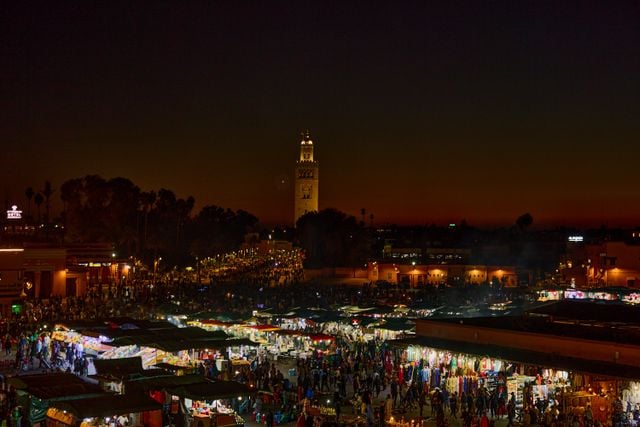
The candid version for anyone booking now: Marrakech in 2026 is a building site in places, extremely good in others, and consistently oversold on its most famous square. Jemaa el-Fna after dark is worth an hour and is a managed spectacle rather than a discovery, with snake charmers, animal handlers and photograph-fee disputes that visitors should simply decline to enter. The souks north of it, the Mellah, the tanneries and the gardens repay far more time than the square does, and the Atlas an hour away repays more still.
Forty-five degrees is not a shoulder-season inconvenience
July and August in Marrakech routinely pass forty degrees, which stops being a question of comfort and becomes a question of what is physically possible between eleven and five. Hotels discount heavily in those months for a reason, and the shaded alleys of the medina are the only part of the city that stays genuinely walkable through the afternoon.
The city works best from October to April, with March and November the strongest compromise between temperature and crowding. Ramadan moves through the calendar and changes the texture of the day completely: many restaurants stay shut until sunset, the pace slows, and the evenings become remarkable. It is a better time to come than most guides suggest, provided a visitor understands what is being observed around them and does not eat, drink or smoke in the street during daylight.
Sources: ATTA: Morocco posts record 19.8m tourist arrivals in 2025 · Hespress: as Marrakech tourism booms, residents weigh the cost of success · UK FCDO: Morocco travel advice, safety and security · Kingdom of Morocco: Al Haouz earthquake reconstruction update
Articles on Read Vault are researched and written by the site’s editorial team.