Lisbon Without Its Funiculars
Sixteen people died on the Elevador da Gloria in September 2025 and the heritage funiculars stayed shut. A city that sells its hills has been climbing them the hard way.
On 3 September 2025 a cable failed on the Elevador da Gloria and a carriage ran down the hill into a building, killing sixteen people and injuring around twenty more. Portugal’s accident investigation bureau found that the cable did not comply with the specifications in force at the city’s transport operator, and in October recommended the funiculars stay out of service until braking systems could hold a cabin after a cable break. Six months on they had not returned. A city that markets its hills has been getting up them without three of the machines built for the purpose, and a visit now has to account for that.
Where the funicular question stands
- The Elevador da Gloria crash happened on 3 September 2025; sixteen people were killed and about twenty injured.
- Investigators found the cable did not meet the specifications in force at the operator, CCFL.
- The October 2025 inquiry recommended closure until brakes could immobilise a cabin after a cable break.
- RailTech reported in March 2026 that Lisbon’s heritage funiculars remained closed six months after the crash.
A cable that did not meet specification
The Gloria line opened in 1885 and worked on a counterweight principle: two cabins joined by a cable, each acting as the brake on the other. When the connection failed, that logic failed with it. Investigators concluded the cable in use did not match the operator’s own specifications, and inspectors were told to verify that braking systems could immobilise a cabin in the event of a break before any service resumed. Final recommendations were expected within a year of the crash.
Sixteen dead is the number, and it should be stated plainly rather than folded into a paragraph about heritage transport. Eleven of the dead were foreign visitors. Whatever the eventual findings on maintenance regimes and oversight, the funiculars are not currently a novelty ride with a queue; they are the subject of an active safety investigation, and the city has been slower to say so on its promotional channels than on its official ones.
There is a wider point about Lisbon’s heritage transport that the crash forced into the open. The trams, lifts and funiculars are simultaneously a working public network, a listed collection of nineteenth-century machinery and a substantial commercial attraction, and those three roles pull maintenance budgets in different directions. Portuguese reporting after the crash raised long-standing questions about inspection regimes on equipment that carries millions of passengers a year.
Four euros a night, seven nights, thirteen and over
Lisbon’s municipal tourist tax doubled to four euros per person per night from September 2024, and it remains the highest nightly city rate in mainland Portugal. It is charged from the age of thirteen, capped at seven consecutive nights, and collected by the accommodation, whether that is a hotel or a licensed short-let apartment.
It frequently does not appear in the headline price at the moment of booking, which means a week for two adults surfaces as an unannounced fifty-six euros at check-in or checkout. Measured against a high-season hotel room the sum is marginal. Measured against a hostel bed it is not, and it is exactly the sort of charge that ought to be quoted up front rather than discovered at a desk.
The 28 was never a funicular substitute, and now it is carrying the load
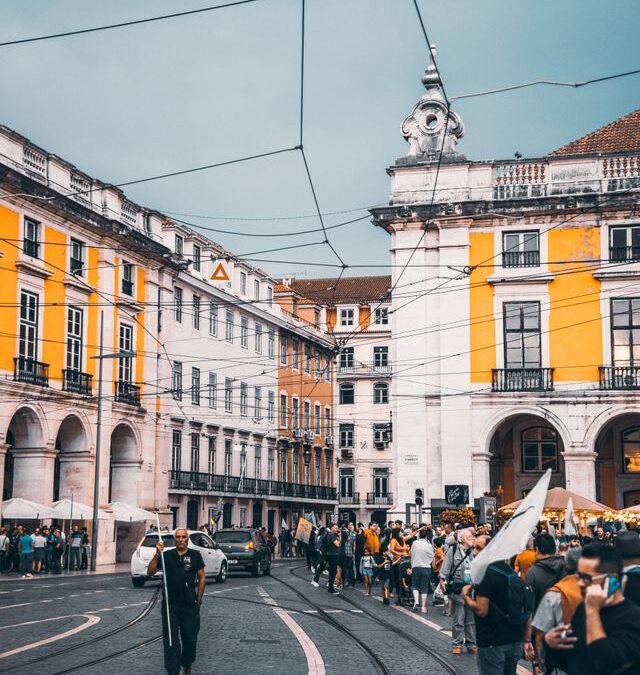
With the hill lifts out, pressure has shifted onto the remaining climbs. The 28 tram is a scheduled service that happens to be picturesque, not a tourist attraction with a fixed timetable, and in high season the queue at Martim Moniz regularly exceeds the wait for anything inside a museum. It is also the single most productive pickpocketing environment in the city, which is not folklore but a standing warning from the operator and from consulates.
The honest alternative is to walk it downhill and take mechanical assistance uphill where it exists. The Santa Justa lift still runs, though its queue has its own reputation. Otherwise Lisbon rewards the traveller who accepts that Alfama, Graca and Bairro Alto are climbs, wears the right shoes, and stops treating the calcada underfoot as decoration; wet limestone paving is genuinely slippery, and the city’s own accident statistics on it are unflattering.
Biometric borders arrived in October 2025
The European Union’s Entry/Exit System began its progressive rollout on 12 October 2025 and reached full operation on 10 April 2026, replacing passport stamping with electronic records of entry and exit for non-EU nationals. France’s foreign ministry, which publishes one of the clearer official explainers, is explicit that there is nothing to do in advance.
The separate ETIAS travel authorisation, which will require an online application before departure, is expected later in 2026. Neither system charges at the border, and neither should be confused with the commercial sites that offer to complete them for a fee.
Alfama emptied of Alfamans before it filled with visitors
The criticism worth making of Lisbon is not that it is crowded but that its centre has been substantially converted. Whole streets of Alfama, Mouraria and Bairro Alto run on short-let apartments, and the fado houses that sell the neighbourhood’s identity increasingly do so to people who no longer live in it. The four-euro nightly tax is a revenue measure, not a brake on that process.
For a visitor the practical consequence is that the most photographed districts are also the least representative. Campo de Ourique, Arroios, Penha de Franca and the far end of Alcantara are ordinary Lisbon at ordinary prices, ten minutes from the centre, and none of them will appear on a shortlist assembled from photographs.
The other pressure is arrivals by sea. The cruise terminal sits directly beneath Alfama, and on a multi-ship morning the funnel of passengers climbing the same three lanes is the nearest Lisbon comes to gridlock on foot. Anyone with a flexible schedule can simply invert the day, taking Alfama at eight and Belem in the late afternoon, and the city becomes markedly more pleasant for it.
The case for a Lisbon November
Summer in Lisbon means heat, cruise arrivals and queues at Belem that outlast the pastries. The city’s best light is in late autumn and early spring, when the Tagus haze lifts and the afternoons are long enough to be useful.
November is the specific recommendation: cheap, quiet, and wet in bursts rather than continuously, with the museums and the miradouros genuinely accessible. February has similar economics and worse weather. June brings the Santos Populares street festivals, which are excellent and are the opposite of a quiet trip.
One further consideration for autumn and winter travel. Lisbon’s building stock is poorly insulated and heating is often minimal, which is why a city that rarely drops below ten degrees can feel colder indoors than a northern one. Guest reviews that mention damp in January are usually describing the housing rather than the weather.
Sintra needs a plan, and most people arrive without one
Sintra is forty minutes from Rossio by train and is the most commonly mismanaged day out from Lisbon. The palaces sit at the top of a wooded hill served by a single narrow road, the bus that climbs it fills by mid-morning, and the queue at Pena is for the interior rather than for the grounds. Timed entry applies at the main sites, so an unbooked arrival at eleven can mean an afternoon slot or none.
The version that works is unglamorous: an early train, one palace booked in advance rather than three attempted, and the walk down through the park instead of a second bus queue. Quinta da Regaleira and Monserrate absorb crowds far better than Pena does. Anyone with only one day and a low tolerance for queueing would get more from Belem and a boat across the Tagus to Cacilhas.
Sources: Al Jazeera: inquiry recommends Lisbon funicular closure · RailTech: six months after crash, Lisbon’s heritage funiculars remain closed · idealista: tourist tax in Portugal, 2025 rates · France Diplomatie: the EU Entry/Exit System
Articles on Read Vault are researched and written by the site’s editorial team.