Who Will Be Running These Devices in Five Years: Nanoleaf’s New Owners and the Nest Hub’s Missing Successor
Light panels and a smart display are not rival purchases. Both now depend on companies whose intentions for them are unclear, and for one of the two that changes on 4 September 2026.
Nanoleaf Shapes are decorative wall panels. The Google Nest Hub is a kitchen counter display. No one cross-shops them, so this is not a head to head; it is one risk seen from two directions. Nanoleaf was sold in May 2026 to the Shenzhen company behind SwitchBot, at a price its own accounts go a long way toward explaining. Google’s entire smart display line was reported out of stock on 21 August 2026 with no successor announced, and Google starts removing Google Assistant on 4 September, three days after this was written.
Where each one stands, 1 September 2026
- Nanoleaf Shapes Hexagons Smarter Kit: $107.99, listed at $119.99, in stock from Nanoleaf’s US warehouse
- Nanoleaf revenue was $30.9 million in 2025 with a net loss of $1.7 million, after a $6.4 million loss in 2024
- OneRobotics, SwitchBot’s Hong Kong listed parent, announced a $40.5 million staged purchase on 15 May 2026
- Google Nest Hub 2nd gen: still shown at $99.99 on Google’s own store, the launch price from March 2021
- Android Authority found the Nest Hub, Nest Hub Max and Pixel Tablet all out of stock together on 21 August 2026
A buy button with nothing behind it
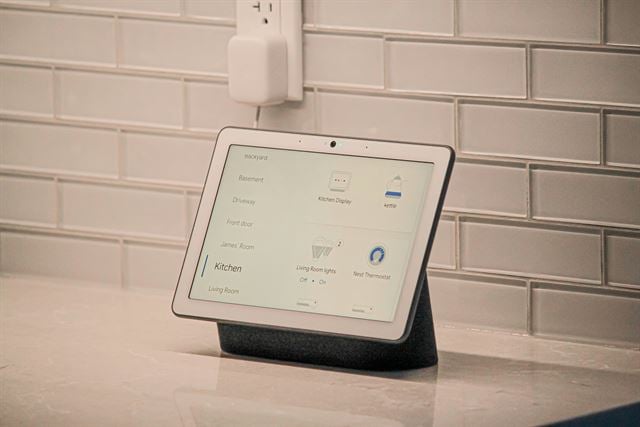
Google’s store still presents the Nest Hub (2nd gen) at $99.99, or four payments of $25, with a working Buy button and no discontinued or out of stock messaging anywhere on the page. Android Authority reported on 21 August 2026 that the Nest Hub, the Nest Hub Max and the Pixel Tablet were all completely out of stock at the same moment, leaving only an email notification option, and that Google had not responded to its enquiry.
No replacement has been announced. Google’s head of Home, Anish Kattukaran, has said the company is definitely still committed to smart displays and will have news to share soon, which is a sentence without a device, a price or a date in it. The only concrete trace of a successor is code: a Google Home Display reference spotted in the Google Home app on 13 May 2026 by a developer, with no announcement attached.
A five year old product at an unchanged price, with an empty warehouse and a promise instead of a roadmap, is not a purchase. It is a bet on a company’s mood.
The assistant is being taken away and its replacement is slower
Google began removing access to Google Assistant on 4 September 2026, a process it says may take a few weeks to reach everyone, covering Android phones, tablets, Wear OS watches and paired devices. Once it is gone you cannot switch back. Tom’s Guide notes that Google TV and Google Home devices keep Assistant for the moment, so a Nest Hub on the counter is not silenced this week. The direction, though, is not ambiguous.
What replaces it has been landing badly. TechRadar reported in April 2026 that users were seeing seven to ten second delays on commands as basic as switching on a light, and in the worst cases delays of around five minutes on routines. One user’s verdict, quoted in that piece: ‘It is so slow to trigger my home commands, it is almost worthless.’ Google’s own remediation claim was a 40 percent reduction in smart home latency, which is an admission of how large the regression was, delivered alongside a rollout to sixteen more countries.
This is the part of a smart display that cannot be worked around. The screen is a shell for an assistant, and the assistant is being swapped out from the far end of a network connection.
Forty and a half million dollars, paid in instalments, for shelf space
Nanoleaf’s situation is different in kind and similar in effect. On 15 May 2026 OneRobotics, the Hong Kong listed parent of SwitchBot, announced a staged acquisition of Nanoleaf worth about $40.5 million, structured across four closings over 24 months, with the later stages conditional. inside.lighting reports the underlying accounts: revenue of $29.7 million in 2024 rising to $30.9 million in 2025, against net losses of $6.4 million and then $1.7 million. The company has never been profitable.
The read on the buyer’s motive is the uncomfortable part. inside.lighting describes the deal as a channel play rather than a technology bet, with OneRobotics acquiring Nanoleaf’s Best Buy, Costco, Apple and Home Depot placement in order to push sports robotics, companion robotics and home service robots into the stores that currently stock light panels. Nothing in that account is a commitment to keep developing wall panels, and no public statement guaranteeing continuity of the Nanoleaf app and cloud for existing owners has appeared.
The founders are contractually locked in for at least three years after closing and SwitchBot has said the two brands will operate separately. That is a reasonable near term signal. It is not a five year one.
One of these keeps working without its maker, and the other does not
Here the two devices genuinely diverge, and it comes down to protocol rather than corporate news. A Shapes Hexagons kit ships with a built in Thread border router and supports Matter, and Nanoleaf’s own product page lists Apple Home, Google Home, Alexa and SmartThings. Panels driven through Matter by an Apple or Google hub do not need Nanoleaf’s servers to turn on. If the Nanoleaf app were ever to go dark, what you would lose is the effects and the scene library, not the light.
Nanoleaf also has a precedent for how it retires a line. It pulled the original Rhythm Light Panels from sale in January 2022, stopped adding firmware features, and kept existing units working, honouring the two year warranty and continuing app support. That is a soft landing, and it is the most useful thing anyone can say about what new ownership might mean.
The Nest Hub’s precedent runs the other way. 9to5Google documented Google removing third party Assistant voice apps and the Games tab from Nest Hub devices in June 2023, taking third party notes and lists integrations with them; the deprecation was announced in June 2022 and executed a year later. Sleep Sensing, meanwhile, has been a free preview since 2021, and Google’s own help page says only that it is excited to explore how this could become part of a paid health experience. A display’s capabilities are a rental agreement with a company, revisable at that company’s convenience.
So: the panels are worth buying as lights at $107.99 if you like them as objects, provided you drive them through Matter and treat the app as the disposable part. The Nest Hub at $99.99 is not worth buying today, from a line with no stock, no announced successor and an assistant being replaced under it. If you already own one it will keep working. What it will still do in two years is the open question, and the answer above is not encouraging.
Sources: Android Authority · Tom’s Guide · TechRadar · inside.lighting · 9to5Google
Articles on Read Vault are researched and written by the site’s editorial team.