Nanoleaf Shapes Hexagons: The Panels Are Fine, the Company Was Just Sold
Nanoleaf was acquired by SwitchBot's parent in May 2026 for about 40.5 million dollars after two loss-making years. Thread and Matter are why the panels are still a reasonable buy.
On 15 May 2026, OneRobotics, the Shenzhen-based and Hong Kong-listed parent of SwitchBot, announced it was buying Nanoleaf for 40.5 million dollars, staged across four closings over 24 months with the later ones conditional. Nanoleaf has never been profitable. None of that stops a Shapes Hexagons kit from working: it ships from a US warehouse at $107.99, carries a built-in Thread border router and Matter support, and asks for no subscription. It does change what a buyer is signing up to, and it is the first thing worth understanding.
A 40.5 million dollar sale, paid in four instalments
The exact figure filed was 40,536,679 dollars, and the payment schedule is the informative part.
- First closing: 9,016,750 shares, 13,525,125 dollars
- Second closing: 5,333,333 new shares, 8,000,000 dollars
- Third closing at twelve months: 6,000,000 founder shares, 9,000,000 dollars
- Fourth closing at twenty-four months: employee shares, 10,011,554 dollars
- Later stages are conditional. If closing conditions are not met or waived, OneRobotics is not obliged to pay.
What the buyer said it wanted, and what it did not say
Founders Gimmy Chu and Christian Yan, the chief executive and chief operating officer, are contractually held for at least three years after closing, and SwitchBot has said the two brands will operate separately on their own. Those are reassuring noises as far as they go.
What is missing is more specific. Nanoleaf had not commented publicly on the deal as of the reporting, and no statement guaranteeing continuity of the Nanoleaf app or cloud services for existing Shapes owners has surfaced. For a product whose scenes, effects and firmware updates come through that app, the absence of such a statement is the relevant gap.
There is a precedent for how Nanoleaf retires a line, and it is not alarming. When the original Rhythm Light Panels were pulled in January 2022, existing units kept working, the two-year warranty was honoured and app support continued; what stopped was new firmware features. Owners were left with what they had, functioning, and nothing more.
Two loss-making years behind the app your panels talk to
Revenue went from 29.7 million dollars in 2024 to 30.9 million in 2025, with net losses of 6.4 million and 1.7 million respectively, a cumulative 8.1 million lost across the two years. The sale went through at roughly 1.3 times price-to-sales, characterised in trade coverage as heavily discounted.
The read on the buyer’s motive is blunter still. inside.lighting describes the deal as a channel play rather than a technology bet: what OneRobotics wants is Nanoleaf’s shelf space in Best Buy, Costco, Apple stores and Home Depot, to push sports robotics, companion robotics and home-service robots into the aisles that currently carry light panels. If that reading is right, the panels are the entry ticket, not the asset.
One power supply, 21 panels, then you buy another
The hard limit both TechRadar and Tom’s Guide identify is the power adapter: it supports up to 21 panels, and going beyond that means adding another supply. Nanoleaf sells Smarter Kits in 5, 7, 9, 10, 12, 13, 15, 16 and 18-panel configurations in White and Ultra Black, all listed in stock from the US warehouse, so a single kit never hits the ceiling. Two rounds of expansion will.
The other physical complaints are consistent across both reviews. TechRadar called the linkers ever so slightly delicate and said the foam mounting fixings feel a little cheap given the price tag, with an explicit warning against mounting on wallpaper. Tom’s Guide, reviewing at a $199 kit price, judged the panels less practical than Philips Hue bulbs or ordinary lighting, which is fair: these are a wall decoration that emits light, not a lighting solution.
Cost is where the two reviews were hardest. TechRadar called Shapes far from a cheap kit when the nine-panel starter set carried a $179.99 list price and a three-panel expansion pack cost $69.99, which is where the ceiling starts to bite: two expansions on top of a fifteen-panel kit and you are shopping for a second power supply as well as more hexagons.
Why Thread and Matter make the ownership question survivable
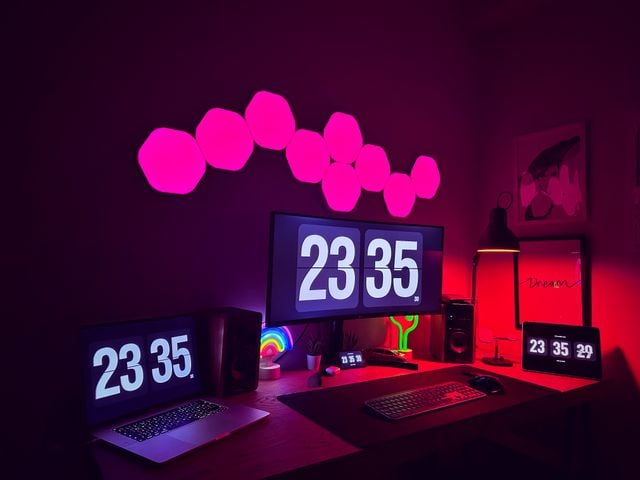
The Shapes line has not been superseded. No successor has replaced it in Nanoleaf’s own catalogue, and the seven-panel Hexagons Smarter Kit, SKU NL42-5003HX-5PK, lists at $107.99 against $119.99, shipping in one to two business days. The box holds panels, controller, a Type-A power supply, rigid linkers and mounting supplies. Colour range is 16 million-plus, white range 1200K to 6500K. There is no subscription and no paywalled feature.
Colour options are White and Ultra Black, and the ceiling on a single kit is 18 panels, so the largest configuration Nanoleaf sells sits comfortably inside what one adapter will drive. That is worth planning around: buying the size you want in one go is cheaper and simpler than assembling it from a small kit and two expansions.
The panels support Matter and contain a Thread border router, and they work with Apple Home, Google Home, Alexa and SmartThings. That is what makes the corporate situation tolerable rather than disqualifying. Power, brightness, colour and scene recall live in whichever Matter controller you already use, so those survive independently of what happens to Nanoleaf’s own servers. The elaborate effects and layout tools, which are the actual reason to buy hexagons instead of a lamp, do not: they live in the Nanoleaf app.
At $107.99 the value case is better than it was at the $179.99 the nine-panel kit commanded at review, and the objection that these are expensive decoration is weaker than it used to be. Buy them for what they do the day they arrive. Do not buy them on the assumption that the effects library will keep growing, because the company that would grow it lost money in both of the last two reported years and has just been bought by a robotics firm that wants its shelf space.
Sources: Nanoleaf · MiniChart · inside.lighting · TechRadar · Matter Alpha
Articles on Read Vault are researched and written by the site’s editorial team.