‘No Hub Required’ Means Three Different Things: Kasa’s Plugs, Nanoleaf’s Panels, and What Is Doing the Routing

A four-pack of smart plugs and a set of light panels are not alternatives. They do share a claim printed on both boxes, and it means something different on each one.
Nobody chooses between a four-pack of Kasa plugs and a wall of Nanoleaf hexagons. One switches a lamp, the other is decoration that happens to be addressable. What puts them in the same basket is a phrase on both boxes, and on most boxes in this category: no hub required. On a Kasa plug it means the plug is a Wi-Fi client talking to TP-Link’s app. On Nanoleaf Shapes it means the panels contain a Thread border router and can carry traffic for other people’s devices. Those are opposite situations, and only one of them makes a network simpler.
A Wi-Fi plug is its own client, and the app is the hub
The EP25, sold in fours as the EP25P4, is TP-Link’s Plug Slim with energy monitoring: 100 to 120VAC, 15A, a 1.8kW maximum load at 120V, UL certified, a two-year warranty, and real-time and historical energy figures inside the Kasa app. It joins a 2.4GHz network directly. Four plugs are four more clients on the router, four more devices holding an account credential, and four devices whose automation logic lives in a vendor cloud rather than in anything under your roof.
The shelf label also hides three separate products. The EP25 is current. The HS103P4 Plug Mini is older, has no energy monitoring, and TP-Link’s own page for it renders without specifications, price or compatibility, so its sale status cannot be confirmed from the manufacturer at all. The third is the KP125M, which is the Matter-certified plug: it can be commissioned by QR code from the Alexa, Google Home or Apple Home app, with the Kasa app never entering the picture. If the appeal of ‘no hub required’ is fewer vendor dependencies, that model number is the one that delivers it, and it is not the one on most four-pack listings.
The panels arrive carrying a border router
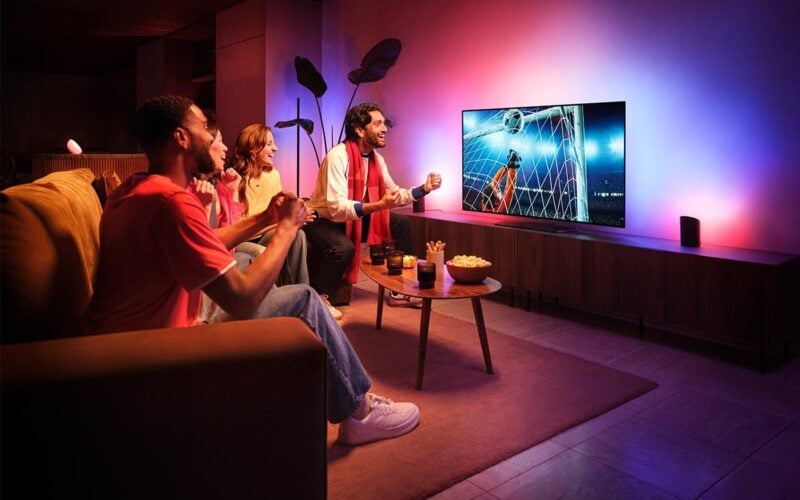
Nanoleaf’s Shapes Hexagons Smarter Kit, SKU NL42-5003HX-5PK, was $107.99 on Nanoleaf’s US store on 1 September 2026, down from a $119.99 list, shipping in one to two business days from the US warehouse. The specification that matters here is easy to miss under the colour claims: the controller is a Thread border router and the panels speak Matter, which is why the same kit lists Apple Home, Google Home, Alexa and SmartThings without asking anyone to buy a bridge.
So the panels are not hub-free. They are part of the hub, and installing them changes how every other Thread device in the house finds a route home. There is also a ceiling the marketing does not lead with. TechRadar’s review records that the supplied power adapter supports up to 21 panels, after which the next purchase is another power supply rather than more hexagons. The same review calls the linkers slightly delicate and the foam mounting fixings cheap for the price, and warns against mounting on wallpaper.
Every border router you add can start another network
This is where the tidy version of the story falls apart. Thread 1.4, published in autumn 2024, exists largely to fix it. It standardises credential sharing, so a border router can grant temporary admin access to a new hub through a one-time passcode, and improves IPv6 routing so devices from different vendors land on one network instead of in vendor islands. Since 1 January 2026 it has been the sole certification standard for new border routers.
Adoption has run behind the specification. Bitdefender’s account of the rollout lists the symptoms owners actually report: devices disconnecting and reconnecting unpredictably, several Thread networks appearing in an app and refusing to merge, new hubs spawning further fragments rather than joining what already exists, and extra battery drain as devices hunt for a parent router. Apple has shipped 1.4 through the tvOS 26 rollout, while Google, Amazon and Samsung were at various stages of testing and planning.
The practical implication for these two products is asymmetric. Adding four Kasa plugs adds no routing complexity and no Thread anything; it adds cloud dependency. Adding a Nanoleaf kit adds a border router to a house that may already have two, and whether they consolidate depends on software none of the three vendors control jointly.
The products that admit to needing a bridge
Philips Hue is the counterexample, and it shows that owning a bridge does not buy neutrality either. The Hue Bridge Pro, launched in September 2025, raises capacity to more than 150 lights and more than 50 accessories against the older bridge’s 63 devices, and moves from 16MB of memory to 1GB of DDR4 with USB-C power, 0.1W standby and up to 500 scenes.
Two limits survive that hardware jump, and both matter more than the specifications. Hue’s Matter integration runs one way: Hue devices are exposed to Matter ecosystems, while third-party Matter devices still cannot be added into the Hue app. And the entertainment sync group is still capped at one group of ten lights per bridge, a Zigbee constraint the new bridge does not lift. A hub in the house does not mean one app for the house.
How to read the claim on the next box you pick up
- If you are buying Kasa plugs in 2026, buy the KP125M rather than the EP25 or the EP25P4. The Matter model costs roughly the same and is not tied to one vendor’s app.
- Treat Nanoleaf Shapes as a Thread node you are installing deliberately, not as decoration, and count the 21-panel power-supply limit into the budget before ordering expansion packs.
- Count the border routers already in the house before adding an ecosystem. Thread 1.4 makes consolidation possible; it does not make it automatic.
- Read ‘no hub required’ as ‘the dependency is somewhere you cannot see’. A Wi-Fi plug depends on your router, your internet connection and a manufacturer’s cloud, none of which are in the box.
- Expect to own a bridge eventually anyway, and choose it on capacity and on which direction its integrations run, not on the number of lights in the starter kit.
Sources: Kasa Smart (TP-Link) · Nanoleaf · TechRadar · Bitdefender · Hueblog
Articles on Read Vault are researched and written by the site’s editorial team.