Soundbars: The One Bar We Can Report On, and the Checks That Matter Before Any Purchase
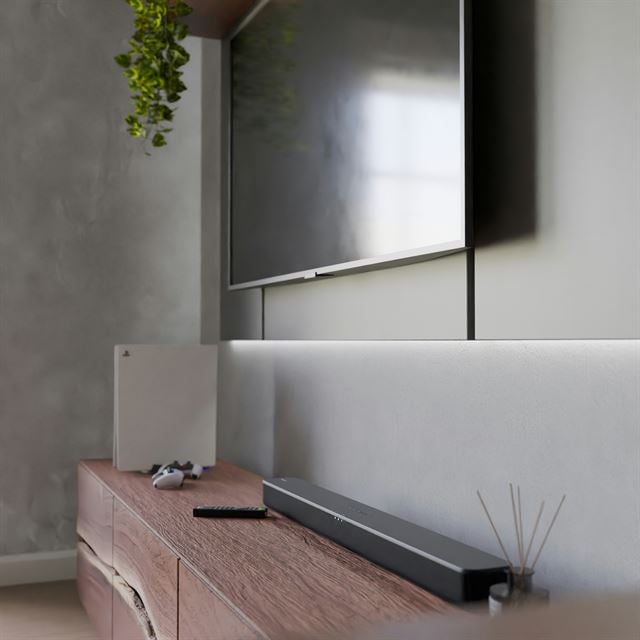
This is not a ranked round-up, and saying so is the point. Our verified price and review research covers exactly one soundbar, so that is the one discussed here and the rest is method.
Most soundbar guides rank ten products. This one cannot, and admitting that is more useful than manufacturing nine opinions. The checked price and published-review research behind this page covers a single bar in any depth: the Sonos Beam (Gen 2), released in October 2021, listed at 499 dollars on Sonos’ own US store on 1 September 2026, against a launch price of 449. Everything else below is the set of questions we would put to any soundbar before paying for it, with the Beam as the worked example.
Key facts
- Sonos Beam (Gen 2), released October 2021 at 449 dollars (TechRadar)
- Listed at 499 dollars on Sonos’ US store, checked 1 September 2026
- No Gen 3 exists; the step up is the Sonos Arc Ultra, released October 2024 (Wikipedia)
- Five class-D amplifiers, one centre tweeter, four elliptical midwoofers, three passive radiators, no up-firing drivers (Sonos)
- Trueplay room tuning still works only from iOS devices (TechRadar)
Why this page is not a ranked list of ten bars
A ranked round-up implies that somebody compared the entries. Where the underlying research contains one soundbar with a published specification, a named-outlet review and a price read off the manufacturer’s own store on a stated date, a list of ten would require nine products whose prices and performance we would be inventing.
The cost to you of that honesty is real: this page will not tell you which bar is best under 300 dollars. The benefit is that everything it does tell you is attributable. If you want a ranking, the question to ask of any you find is which of its entries the writer had measurements for, and on what date the prices were checked. In a category where a Roku bar rose 50 percent in a single July, an undated price is not a price.
It is also worth being clear about what a soundbar review can and cannot establish in general. Frequency response and distortion are measurable. Whether a bar sounds right in your room is not, because the room is half the instrument, and it is the half no reviewer has access to. That is why the calibration question further down matters more than most published verdicts do.
Five amplifiers, four midwoofers, and nothing aimed at the ceiling
Sonos specifies the Beam (Gen 2) with five class-D digital amplifiers, one centre tweeter, four elliptical midwoofers and three passive radiators, connected by HDMI eARC or ARC with a 4.9 foot cable, and supporting Trueplay tuning, AirPlay 2, Sonos Voice Control, Alexa and Google Assistant. Sonos describes its Dolby Atmos as delivered through phantom height channels.
That phrase is doing a lot of work, and a buyer should read it literally. There is no driver in this bar pointing upward. Height information in an Atmos mix is synthesised by processing rather than reflected off your ceiling, and TechRadar’s review states plainly that it did not produce the overhead sound of the larger Sonos Arc while still calling the Beam a strong upgrade on the original with Atmos support, eARC and a refreshed design.
The same review names a second limitation that survives to this day: Trueplay, the room-calibration routine that adapts output to your furniture and walls, only works from iOS devices. An Android household buys the hardware and cannot run the tuning step that a good part of the product’s reputation rests on. TechRadar also noted that the Gen 2 costs more than its predecessor, and five years later it costs 50 dollars more again.
A control app is a dependency, and in May 2024 that dependency failed
The single most instructive thing about this category is not an acoustic measurement. In May 2024 Sonos shipped a rewritten control app. The alarm and the sleep timer were removed, the visual design was poor and accessibility support was inadequate. None of that was a choice made by the people affected, because the update replaced the control software for speakers already sitting in their homes.
The consequences ran through the company. Chief executive Patrick Spence apologised in July 2024. By August, Sonos was considering relaunching the old app after overwhelmingly negative Google Play reviews, and laid off 100 employees, following a separate cut of 130 in June. Spence announced his resignation in January 2025, seen as related to criticism of the rollout. Tom Conrad is listed as the current chief executive.
Recovery has been slow enough to be measurable in years. TechRadar reported on 8 July 2026 that Sonos had only in recent months moved from fixing the app’s technical faults to improving it, and that users were building third-party alternatives because the official app still would not do what they needed, including adding front left and right surround speakers, switching between home-theatre and music configurations without reconfiguring, saving multiple room-tuning profiles, and UPnP support for local files. On 14 July 2026 the company began a two-week rollout of an update bringing tab navigation with clear selection indicators, speaker reordering and pinning, and an expanding volume slider with numeric values on iOS.
Read that last sentence as a buyer rather than as news. Speaker reordering and a volume slider were shipped as headline improvements more than two years after the rewrite. Any soundbar whose features live behind an app carries this risk, and Sonos is simply the case where it is documented.
The other bar in our price research, and why it is not a recommendation
One other soundbar-shaped product appears in the pricing we verified: the Roku Streambar SE, which Ecoustics recorded rising from 99.99 to 149.99 dollars in Roku’s July 2026 increase, a 50 percent jump attributed by a Roku executive to memory and component shortages driven by the artificial intelligence build-out.
We are not recommending it, and the reason is that we have a price for it and nothing else. No measurement, no named-outlet review, no specification we checked ourselves. Recommending a speaker on the strength of its price tag is the failure mode this whole page exists to avoid, and it would be a worse recommendation now that the tag is half as large again as it was in June.
What to establish about any bar before you pay
These are the five questions worth answering before money changes hands, each of which the Beam answers in a way that is either fine or not depending entirely on your room and your phone.
- Does it have up-firing drivers, or does it synthesise height? Sonos’ own specification for the Beam lists passive radiators and midwoofers, and nothing aimed at the ceiling.
- Does room calibration require a particular phone? Trueplay runs on iOS only, which rules out a whole category of household.
- How old is the design, and is a successor expected? The Beam (Gen 2) is from October 2021 and Sonos lists no Gen 3, with the Arc Ultra of October 2024 as the step up.
- What stops working if the app changes? Sonos removed the alarm and sleep timer from installed speakers in May 2024, and basic navigation fixes were still arriving in July 2026.
- What is the price you can actually pay? Tom’s Guide logged Sonos sales in March, April, May and June 2026 at up to 25 to 30 percent off, so list price is rarely the right number to plan around.
Sources: Sonos · TechRadar · Wikipedia · Ecoustics · Tom’s Guide
Articles on Read Vault are researched and written by the site’s editorial team.