Brooklinen’s Certification Is Real. Most Bedroom “Clean” Claims Aren’t.
The candle this piece was assigned to compare could not be verified to exist. Here's what actually gets tested on a set of sheets — and what doesn't.
Read Vault was assigned to compare Brooklinen’s Luxe sheets against something called the “Yankee-Free Soy Candle Set.” That product does not exist: an exact-phrase search, a brand search, and a retailer search all turn up nothing but the real, differently named brand Yankee Candle. Rather than review a product that can’t be verified, this piece covers what the assignment was actually circling — what a certification on a bedroom purchase is supposed to prove, using Brooklinen’s real, third-party-verified OEKO-TEX label as the example of what a genuine one looks like.
What’s actually certified
- OEKO-TEX Standard 100 on Brooklinen’s Luxe sheets is a third-party test, not a brand claim
- Brooklinen’s “lifetime warranty” against ripping, tearing and pilling is the company’s own wording
- The CPSC banned lead-cored candle wicks in 2003, following a 2001 EPA indoor-air study
- Real soy-candle brands include Yankee Candle’s soy-blend line, Brooklyn Candle Studio, Keap and Grow Fragrance
The Name in the Assignment Doesn’t Exist
Before getting to what does exist: a templated product name like “Yankee-Free Soy Candle Set” reads as a splice of the real brand Yankee Candle with a generic “-free” marketing suffix. No retailer, brand page or exact-phrase search turns up anything by that name. The honest move isn’t to review it anyway or quietly swap in a lookalike — it’s to say so, and to use the space for a question that applies to any bedroom purchase carrying a claim on the label: what does a certification actually certify, and who is checking it?
The method for checking is not complicated, and it’s the same method that surfaced the problem in the first place: search the exact product name in quotation marks, check whether the retailer or brand’s own site lists it, and see whether independent reviews of that specific product exist anywhere. A name that fails all three checks, as this one did, is either a mistake somewhere upstream or evidence that a listing was generated rather than researched. Either way, the product it names shouldn’t be reviewed as though it exists.
What OEKO-TEX Standard 100 Actually Tests
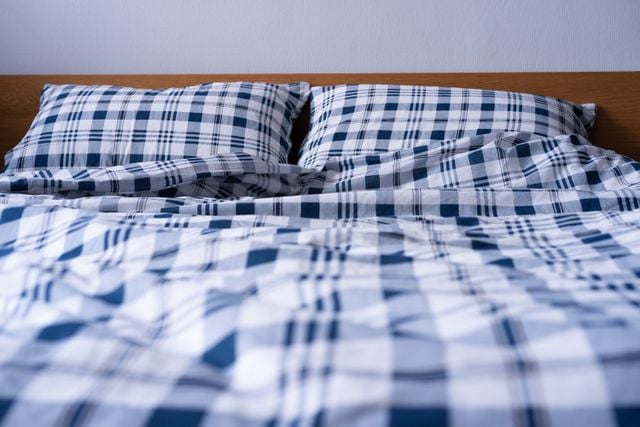
Brooklinen’s Luxe Sateen sheets are certified to OEKO-TEX Standard 100, a third-party certification — meaning an outside body tests the finished textile against a defined list of substances, rather than the brand simply stating a claim about its own product. The sheets themselves are 480 thread count, 100 percent long-staple cotton sateen, made in Portugal, with a fitted sheet cut to a 16-inch pocket depth.
That distinction carries particular weight for sheets, which spend more hours in direct, prolonged contact with skin than almost any other textile bought for a home. A verified third-party test on the finished product is a meaningfully different claim than a brand simply saying its materials are safe, and it’s the kind of claim a shopper can actually check rather than take on faith.
A “Lifetime Warranty” Is Brooklinen’s Wording, Not a Certification
Brooklinen also states that it backs the sheets with a lifetime warranty against ripping, tearing and pilling. That’s the company’s own language about its own product — not a standard verified by an outside lab the way OEKO-TEX is. The distinction matters because reviewers report the sheets not always living up to it: Mattress Clarity gives the set a value score of 3.5 out of 5, and owner reviews describe quality declining after about a year, along with rips and pilling turning up within months in some cases — the exact defects the “lifetime” language promises to cover.
Other reported issues are about comfort rather than durability: sateen traps more heat than a percale weave, reviewers note shade variation between batches, and king-size sets ship with standard pillowcases rather than king-size ones — a mismatch buyers should expect to correct themselves. None of that touches the OEKO-TEX certification, which is specifically about substances in the finished fabric, not about how the sheets perform or hold up over time. A buyer can reasonably trust the certification and still be disappointed by the durability, because the two claims are answering completely different questions.
Returns Run 365 Days, Minus a $9.95 Fee
Brooklinen’s return window runs a full 365 days, considerably longer than most textile returns. It isn’t free: a $9.95 return-shipping fee is deducted from the refund. For a $179 queen set, that’s a small percentage of the purchase price, and the long window gives more time than most retailers offer to notice the durability issues reviewers describe before that window closes.
What Actually Regulates a Candle: the CPSC’s Lead-Wick Ban
If the assignment had named a real soy candle, the one hard regulatory fact worth knowing is this: the Consumer Product Safety Commission banned candles with lead-cored wicks in 2003, through rulemaking published in the Federal Register (68 FR 19071, April 18, 2003). That rule followed a 2001 EPA report, “Candles and Incense as Potential Sources of Indoor Air Pollution,” which found that lead-core-wick candles could push indoor lead levels above EPA-recommended thresholds. That’s a real, binding, third-party rule — the closest thing in the candle category to what OEKO-TEX is for textiles.
Soy wax itself is soybean-derived and burns roughly 30 to 50 percent longer per volume than paraffin, according to industry sources, and the National Candle Association attributes soot mainly to wick length and flame disturbance rather than to the type of wax. “Phthalate-free” has become a common marketing claim because some synthetic fragrance oils have historically contained phthalates, but the health risk from scented candles generally remains inconclusive in the literature — worth knowing before treating either the presence or the absence of that label as a settled safety verdict.
Reading a Label Before You Trust It
The pattern across both categories is the same. A certification like OEKO-TEX, or a rule like the CPSC’s wick ban, comes from an outside body testing against a defined standard. A company’s own “lifetime warranty” wording, or an unverified marketing name splicing a real brand with a trend suffix, does not. Brooklinen’s sheets carry one of the real kind. Whatever soy candle a reader was actually looking for should be checked against a real brand — Yankee Candle’s soy-blend line, Brooklyn Candle Studio, Keap, Grow Fragrance, Slow North, or Pure Plant Home all exist and can be verified — rather than a name that turns out not to.
None of this means every unverified claim is deceptive, or that every certified product is flawless — Brooklinen’s own durability complaints sit right alongside its real OEKO-TEX label. It means the two kinds of claim deserve different levels of trust, and a shopper is better served knowing which kind they’re looking at before they buy either a sheet set or a candle.
Sources: Brooklinen Luxe · Brooklinen returns · Mattress Clarity Brooklinen · CPSC lead wick ban · Healthline nontoxic candles
Articles on Read Vault are researched and written by the site’s editorial team.