Building a Home Office Around a Desk, Not a Chair
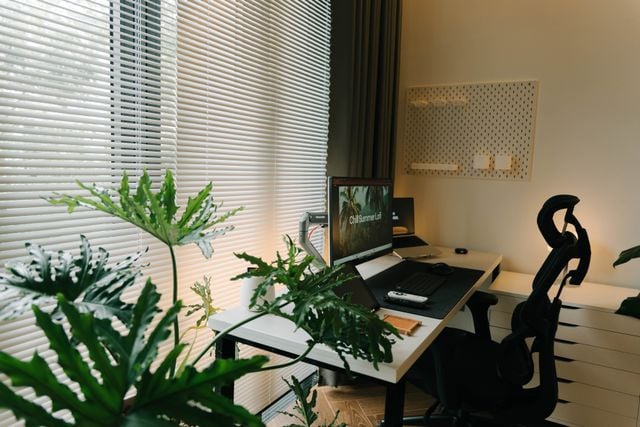
The roster's only real desk pick has a firm height ceiling, and there's no proper office chair in it at all - here's what that means for a real setup.
A comfortable, focused home office needs three things most buying guides skip: a desk that holds its height under load, light tuned for the hours you’re actually working, and air that doesn’t turn a small room stuffy by mid-afternoon. Of what’s available for this piece, one product clears that bar convincingly, two do part of the job with real strings attached, and one category – the chair you’d actually sit in for eight hours – has no honest answer here at all. This is what each one gets right, and where each one runs out.
Key facts
- FlexiSpot E7 frame height range: 22.8 to 48.4 inches; 15-year warranty on frame, motor and controller
- The model reviewers actually recommend, the 4-leg E7 Plus, runs $499.99 to $799.99
- A Philips Hue Bridge (about $60) is required for voice control, geofencing, or more than about 10 bulbs
- Coway Airmega AP-1512HH: AHAM CADR 247.7 dust / 233.6 smoke / 232.2 pollen; HouseFresh measured 60.1 dB at top speed
The height where the base FlexiSpot E7 starts to wobble
The dual-motor FlexiSpot E7 adjusts from 22.8 to 48.4 inches, is rated to hold 355 pounds, and carries a 15-year warranty on the frame, motor and controller (2 to 5 years on the desktop itself, depending on material), according to FlexiSpot’s own product listing. That is a genuinely long warranty for office furniture, and it covers the parts most likely to fail first.
The catch shows up at the top of the height range. TechRadar’s review of the four-leg E7 Plus notes that the standard two-leg E7 shows noticeable movement at maximum height once a heavy monitor setup is on the desktop – movement the four-leg Plus does not show; TechRadar’s reviewer rode the Plus up and down while holding his children without a wobble, at under 50 decibels. Practically, the base E7’s 48.4-inch ceiling makes it unsuitable for anyone taller than about 6 feet 4 inches trying to work standing up, since the desk cannot rise to meet them.
Two smaller annoyances are worth knowing before buying: the T-frame crossbar underneath can contact your shins if you sit close to the desk, and the stock cable tray doesn’t integrate cleanly with the frame, per the same review.
The desk that’s actually recommended costs more than the ad
FlexiSpot advertises entry pricing well under $300, but that figure describes a bare frame, not a desk anyone would use for standing work day to day. The E7 frame alone runs roughly $299 to $339, with a complete desk – frame plus desktop – closer to $369. The version reviewers actually steer buyers toward, the four-leg E7 Plus that solves the wobble problem, runs $499.99 to $799.99, including a $499.99 promotional price against a $599.99 regular price.
That’s not a small gap. Anyone shopping off the headline number and budgeting $300 for a standing desk should expect to more than double that to get the version that doesn’t move under a monitor arm and two hands typing.
Light that can match a working brain, if you buy the extra piece
The Philips Hue White Ambiance bulb – $30.99 for a single A60 rated to 1100 lumens, $48.99 for a two-pack of A19 bulbs at 810 lumens at 4000K – tunes from 2200K warm white to 6500K daylight, roughly the range people associate with alert, focused light versus wind-down light. Over Bluetooth, it handles on/off, dimming and colour temperature with no additional hardware.
Full automation – schedules, voice control, geofencing, or running more than about ten bulbs – needs a Hue Bridge, an additional roughly $60 purchase. Since September 2023, according to Hue engineer George Yianni as reported by Hueblog, a Hue account has been required to use the app at all; Signify never published a firm enforcement date, but setup now depends on both an account and an internet connection even though local control still works once a bulb is configured. The 2025-2026 platform refresh adds features – Bridge Pro, an Essentials tier, SpatialAware scenes – that are gated behind newer hub hardware, so a bulb bought today won’t necessarily get everything Philips ships next.
One more caveat for anyone buying this specifically to dial in a focus-friendly colour temperature through the day: independent long-term reviews report that the tunable white doesn’t render as consistently across the 2200K-6500K range as the marketing implies, which matters if the goal is a precise, repeatable difference between morning light and evening light rather than a rough one.
Air you can measure, at a volume you’ll notice
A home office is usually a small, closed room, which is exactly where an air purifier’s numbers matter. The Coway Airmega AP-1512HH carries an AHAM-verified CADR of 247.7 for dust, 233.6 for smoke and 232.2 for pollen, and Coway rates it for 361 square feet at 4.8 air changes per hour – enough for most home offices with room to spare.
The honest costs are ongoing ones. Consumer Reports estimates $43 a year in filters and $59 in electricity; HouseFresh measured $83.64 a year at top speed and called it the most power-hungry purifier it has tested, and found its ionizer – a feature some owners disable over ozone concerns – adds three minutes to clean the same test room when switched off, meaning the published performance leans on a setting not everyone wants running. At maximum speed, HouseFresh measured 60.1 decibels, loud enough to compete with a phone call in a small room. It’s also worth knowing that Coway’s own current US corporate site no longer lists this unit, favouring rental-subscription models instead – it remains current at retail, just not on the maker’s own current lineup.
The chair this roster doesn’t have
No product available for this piece is a real desk chair, and forcing one into that role would be dishonest. The IKEA POÄNG armchair comes closest – $249, in production since 1976, backed by a 10-year warranty – but it was designed as a lounge chair, not a task chair. Its cushion sits on about 6 centimetres of padding over a bentwood frame, and a Comfort Works review scored its comfort 5 out of 10 against 9 out of 10 for durability; the headrest cushion pushes some users’ heads forward rather than supporting them, and the exposed wood frame reads as bare rather than upholstered.
IKEA’s own page rates the chair to 242 pounds; a third-party site claims 375 pounds without citing IKEA, and that higher figure shouldn’t be trusted over IKEA’s own published number, particularly for a chair someone might be sitting in for most of a working day. That may suit a reading corner next to the desk, but it isn’t built for eight hours of typing, and nothing else here is either. If a real task chair is what a home office needs most, this roster doesn’t have a good answer for it – buy the desk here and shop the chair somewhere else.
Sources: FlexiSpot · TechRadar · Hueblog · HouseFresh · Comfort Works
Articles on Read Vault are researched and written by the site’s editorial team.